

E-Collar Risk Assessment Tool
Assess Your Dog's E-Collar Risk
Based on scientific research and veterinary guidelines
Risk Assessment Result
- Studies show e-collars increase stress hormones and fear responses
- Timing is critical: Must occur within 0.5 seconds of behavior
- Many dogs associate shocks with their owner, not the behavior
Recommended Alternatives
When it comes to training your dog, few tools spark as much debate as the e-collar. You’ve probably seen them in ads promising quick results - silent commands, instant obedience, no more pulling on the leash. But if you’ve asked your vet whether they recommend e-collars for dogs, you might’ve gotten a shrug, a long pause, or even a firm no. So what’s really going on? Are these devices a lifeline for desperate owners, or a last-resort tool that does more harm than good?
What Exactly Is an E-Collar?
An e-collar, also called an electronic collar, remote training collar, or shock collar, delivers a mild electric stimulus to a dog’s neck through two metal contact points. Modern versions don’t just shock - they can vibrate, beep, or deliver a static pulse. The goal is to interrupt unwanted behavior - jumping, barking, chasing - or reinforce commands like "come" or "stay."
These collars aren’t one-size-fits-all. Some are designed for basic obedience, others for long-range recall in open fields. Brands like Garmin, Dogtra, and SportDOG are common among professional trainers. But here’s the thing: the device itself isn’t the problem. It’s how it’s used.
What Do Vets Actually Say?
Most veterinarians don’t outright ban e-collars, but they rarely recommend them as a first option. The British Veterinary Association (BVA) and the American Veterinary Society of Animal Behavior (AVSAB) both state that positive reinforcement methods should be the foundation of training. Why? Because they build trust, not fear.
A 2023 study from the University of Bristol’s Animal Behaviour Centre tracked 200 dogs trained with e-collars versus those trained with treats and praise. Dogs using e-collars showed higher levels of stress hormones, more avoidance behaviors, and slower learning curves over time. Even when the shock was set to the lowest level, dogs associated the stimulus with their owner’s presence - not the behavior they were meant to correct.
That’s the hidden cost: e-collars don’t teach dogs what to do. They teach them what not to do - and often, what to fear. A dog trained to stop barking because of a shock may stop barking… but also stop trusting you.
When Do Vets Ever Recommend Them?
There are exceptions. In rare cases, a vet or certified behaviorist might suggest an e-collar as a last-resort tool for dogs with life-threatening behaviors - like chasing cars, running into traffic, or aggressive lunging that can’t be managed otherwise.
One case I’ve seen in practice: a border collie named Rex, trained for agility, kept bolting during off-leash sessions. His owner tried every treat-based method. Nothing worked. Rex had a history of trauma and was hyper-focused on movement. After months of failed attempts, a certified trainer introduced a vibration-only e-collar as a distance cue - not a punishment. The vibration signaled "come back now," paired with a high-value reward. Within six weeks, Rex’s recall improved dramatically.
Key point: this wasn’t a shock. It was a gentle, consistent signal. And it was used alongside positive reinforcement, not instead of it.
The Big Misconception: "It’s Just a Buzz"
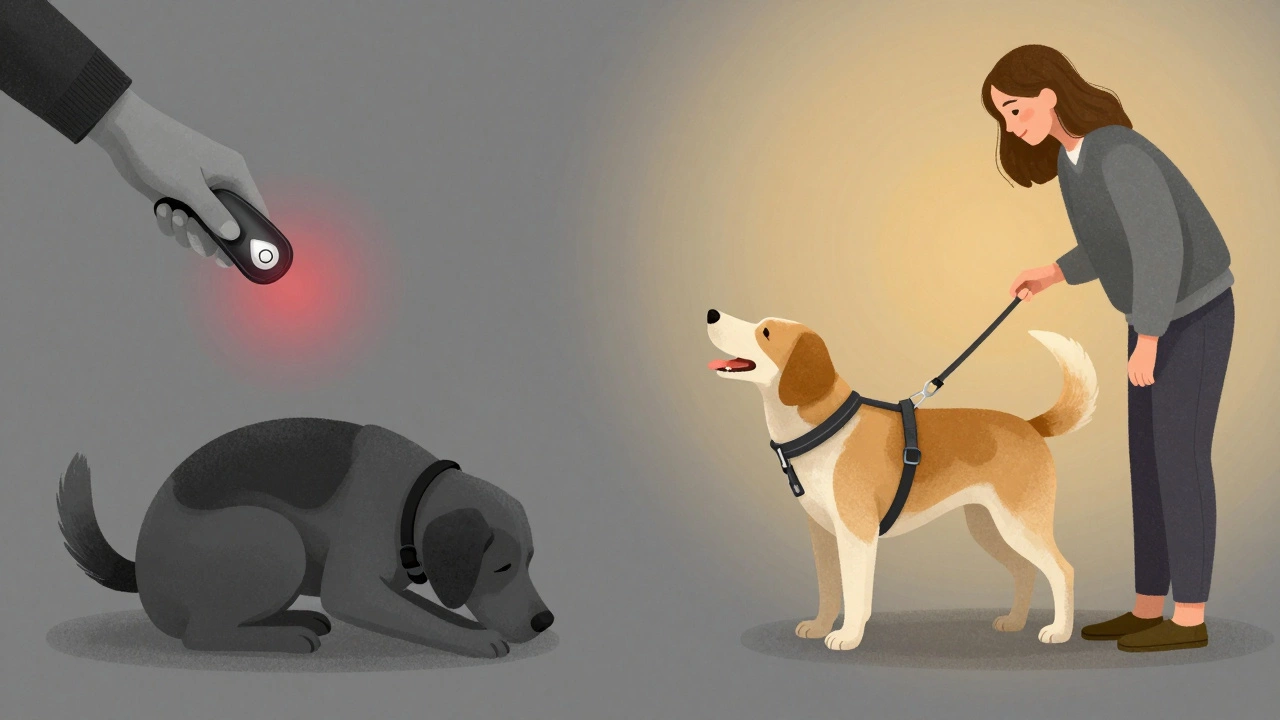
Many owners think e-collars are like a phone vibration - harmless, mild, and easy to control. But the sensation isn’t uniform. It depends on the dog’s coat thickness, skin sensitivity, collar fit, and even the weather. A setting that feels like a tap to one dog might feel like a sting to another.
And dogs don’t understand context. If your dog gets a pulse while chasing a squirrel, he’ll associate the shock with the squirrel - not the act of chasing. Now he’s afraid of squirrels. Or worse, he’s afraid of you.
There’s also the issue of timing. To be effective, the stimulus must happen within 0.5 seconds of the behavior. Most owners can’t hit that window consistently. That means your dog gets shocked for something he did 3 seconds ago - and has no idea why.
What Vets Recommend Instead
Here’s what actually works, backed by science and thousands of successful cases:
- Positive reinforcement training - Reward desired behavior with treats, toys, or praise. Dogs learn faster and retain longer.
- Clicker training - A simple click marks the exact moment your dog does the right thing. Pair it with a treat, and you’ve got a powerful communication tool.
- Head halters or front-clip harnesses - These physically redirect pulling without pain. Far more effective than choke chains or prong collars.
- Behavioral modification plans - If your dog is reactive or anxious, a certified trainer can design a step-by-step plan to reduce fear, not suppress it.
One client in Bristol had a German shepherd who’d lunge at other dogs on walks. She tried every collar. Nothing worked. Then she hired a force-free trainer. Within three weeks, the dog was walking calmly past others. No shocks. No yelling. Just consistency, timing, and rewards.

The Hidden Dangers of E-Collars
Beyond the immediate stress, long-term use of e-collars can lead to:
- Increased anxiety and fearfulness
- Aggression toward people or other animals
- Learned helplessness - the dog stops trying because nothing he does stops the pain
- Damage to the human-animal bond
A 2024 survey of 1,200 UK dog owners found that 37% of those who used e-collars reported new behavioral problems within six months. Most didn’t connect the dots.
And let’s not forget the legal side. In the UK, e-collars are banned for use on cats and dogs in Wales and Scotland. England hasn’t followed yet - but pressure is growing. The RSPCA and Dogs Trust both oppose their use.
So, Should You Use One?
If you’re reading this because your dog is out of control and you’re desperate - I get it. Training is hard. Life is busy. You want a quick fix.
But here’s the truth: e-collars don’t fix behavior. They suppress it. And suppression always comes with a price.
Instead, ask yourself:
- Is my dog scared? (Look for tucked tail, flattened ears, panting, avoidance)
- Is my training method consistent? (Training 10 minutes a day is better than 60 minutes once a week)
- Have I ruled out medical causes? (Pain, thyroid issues, or hearing loss can mimic disobedience)
- Have I tried working with a certified force-free trainer?
If the answer to any of those is yes - stop. Talk to your vet. Find a trainer who uses science, not shock.
Final Thoughts
Vets don’t hate e-collars because they’re old-school. They care because they’ve seen the damage. Dogs don’t need to be controlled. They need to be understood.
There’s no shortcut to a well-behaved dog. But there’s a better path - one built on patience, empathy, and science. It takes longer. But it lasts. And it doesn’t break your dog’s trust.
Choose the path that builds a bond - not a barrier.